
This page is written with students as the target audience.
The purpose is to show how the Transferflow model is experienced "from the inside" - as a student in a teaching process.
At the bottom of the page you will find a short summary directly for you as a teacher.
A course with clear purpose and coherence
As a student, you encounter the teaching "from the beginning":
first the asynchronous work, then the synchronous and finally the project.
But even though it is experienced step by step, it is all connected from the start.
You start by getting an overview and direction
Early in the process, you as a student will be introduced to what the work will result in.
Not as a ready-made checklist, but as a clear direction:
What should I end up being able to show, explain or take a position on in the project?
This means you're not working "blindly." You know what you're working towards, and it gives you both direction and a sense of purpose—even before you actually get started.
Asynchronous part: You build your knowledge base
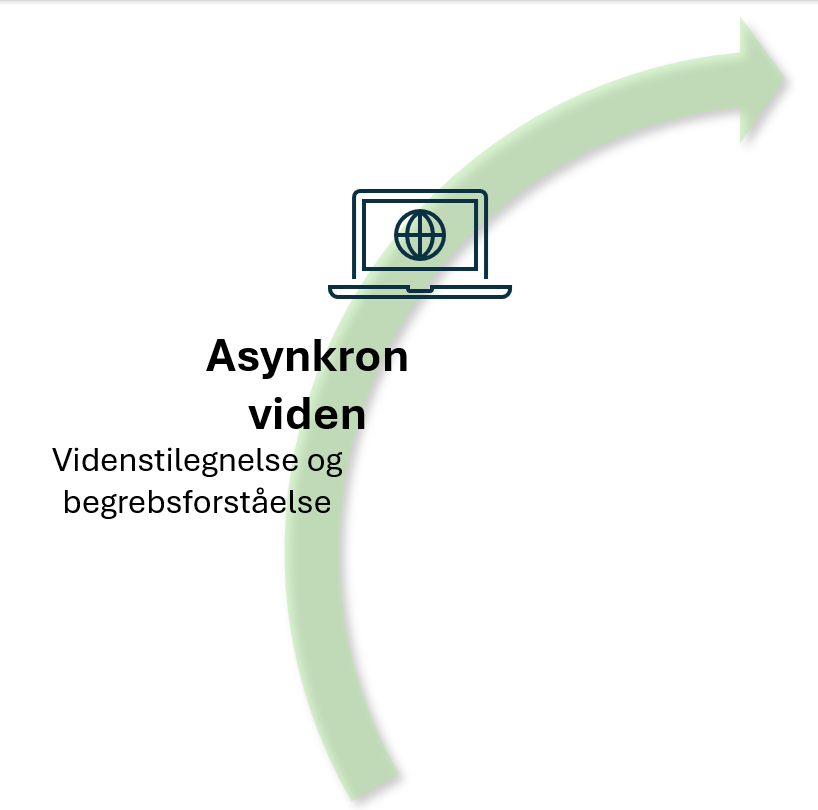
In the asynchronous part, you will not encounter tasks or exercises.
Here you will encounter learning objects: videos, texts, explanations and examples, which together build the knowledge base you will need later.
The content is not randomly selected.
It is carefully selected based on one central question:
What do you as a student need to know to be able to work meaningfully with the scaffolded tasks in the synchronous part?
The asynchronous part allows you to:
- work at your own pace
- return to the material
- create overview and coherence
- Prepare yourself mentally and professionally for what is to come
This is where the foundation is laid.
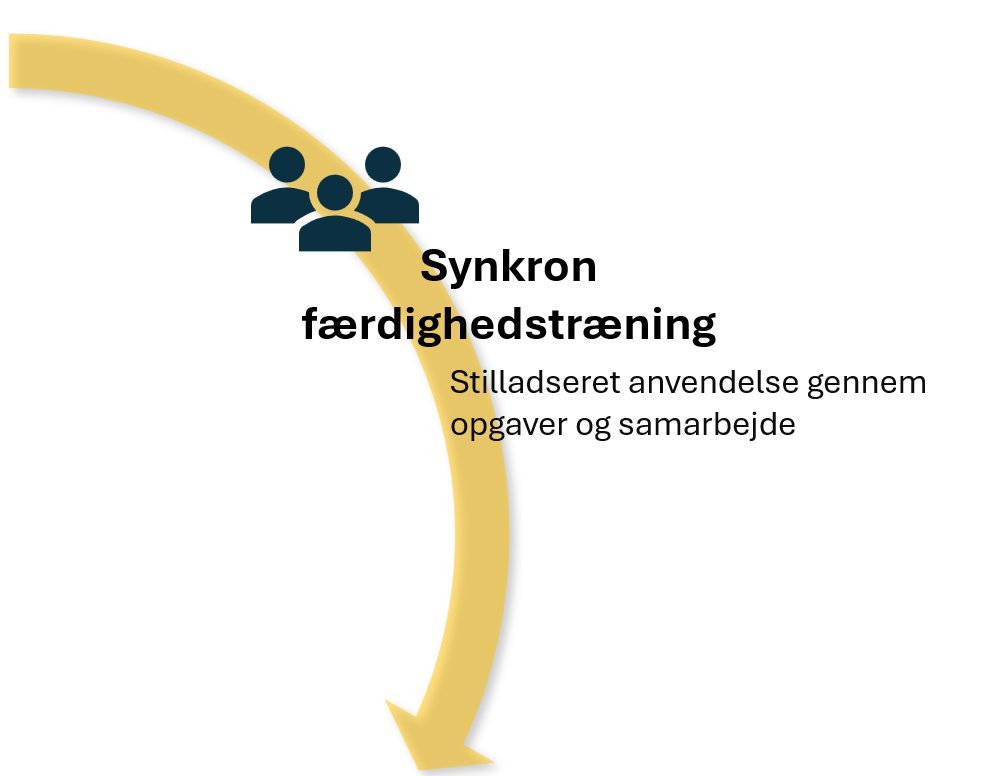
Synchronous part: Knowledge is translated into action
In synchronous teaching, you work together with others—often through scaffolded tasks that require you to actively apply your knowledge.
You are not just asked to “solve something”.
You are asked to:
- apply concepts
- make a choice
- explain your considerations
- deal with solutions and alternatives
Already here it is clear how what you are doing is connected to the project part. You can see the connection between:
- what you have learned
- what you practice
- what you will later be able to independently achieve
It is precisely this context that makes the work meaningful – even when it is difficult.
The project: Independence with a professional focus
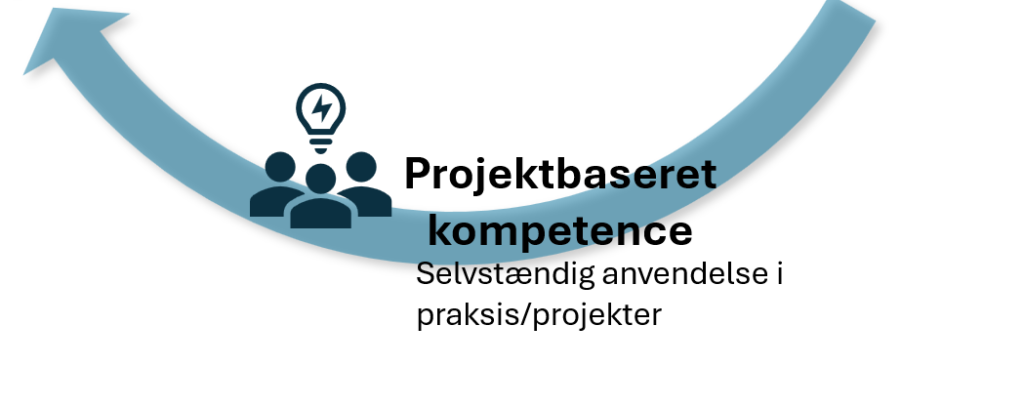
In the project part, you work more independently.
Here you are not "let loose" without any framework - but you have more responsibility.
You use:
- the knowledge you have built up
- the skills you have trained
- and develops skills in planning, prioritizing and making professional choices
The key is not only what you achieve, but how you use your knowledge and skills in an appropriate way.
Summary – for the teacher
From the student's perspective, the Transferflow model is experienced as a coherent process with a clear purpose:
The project provides direction
- Synchronous teaching provides training and testing
- The asynchronous part provides the necessary knowledge base
Although the process is experienced from the front by the student, it is planned from the back.
It is precisely this shift that makes it possible to create teaching where students:
A reflection for the teacher
That's how the model is conceived.
But that's not always how it's experienced.
Sometimes the planning doesn't quite work.
Other times the scaffolding doesn't work as expected.
The students may have overlooked something, be unprepared – or be in a different place academically than expected when the asynchronous part started.
And that's totally okay.
All teaching can go wrong from time to time.
The important thing is not that everything works perfectly, but that you discover it, italize it and help students get back on track.
The Transfer Flow Model is not a guarantee against errors –
but a common language and structure that makes it easier to adjust, explain and restore coherence when something does not work as intended.