A simple, coherent framework for online learning
Here you will get a simple overview of the key elements of the Transflow model and their value for educators and their students.
Students' perspective
A brief introduction to how the model is reflected in teaching and gives students a sense of coherence.


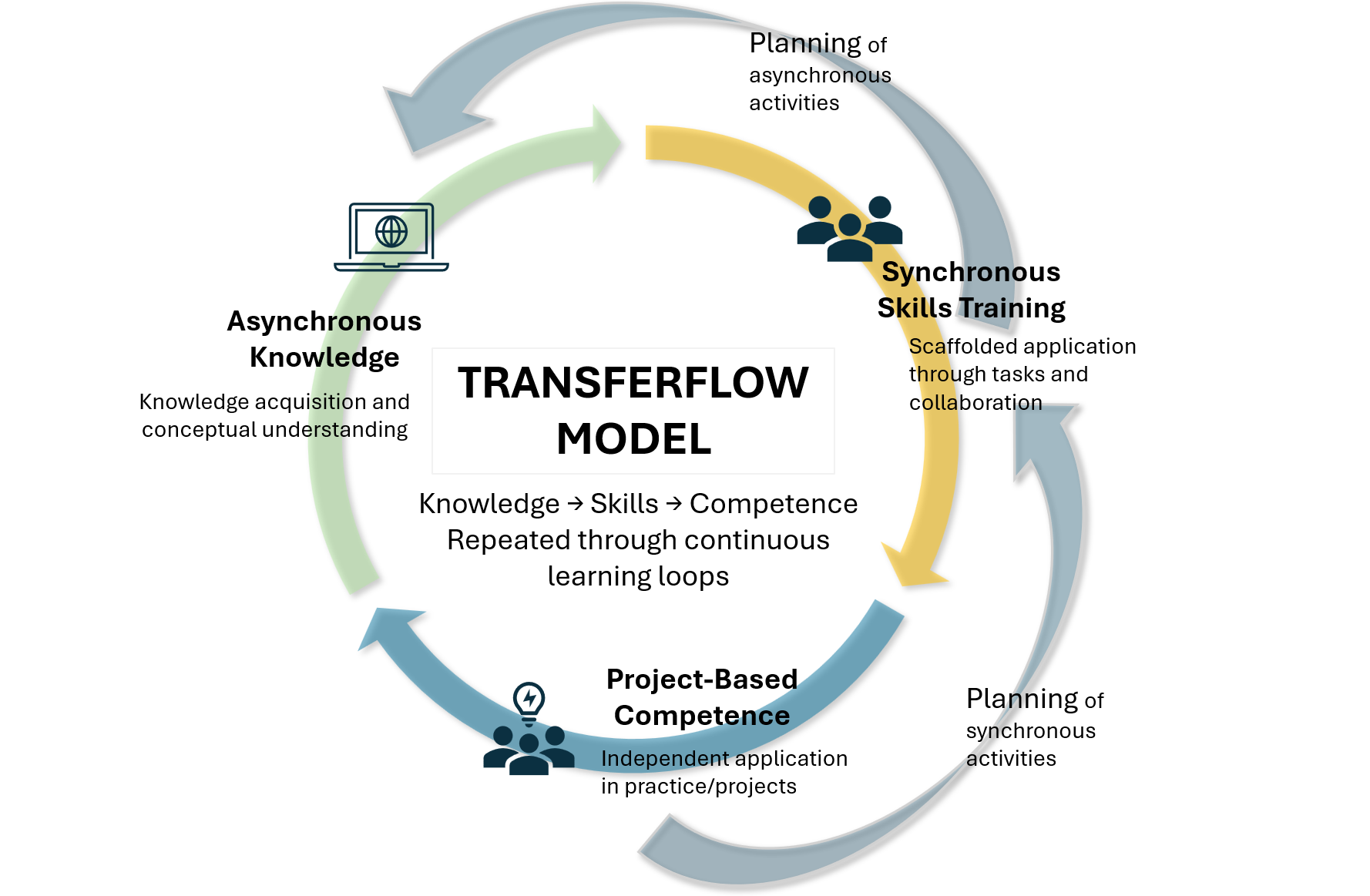
First step: Asynchronous knowledge acquisition
The students start here.
Here they gain the basic knowledge that will be used for the tasks they will later encounter together.
Focus: understanding, concepts, connections.

Second step: Synchronous skills training
Here we work together – typically in groups – with scaffolded tasks that build directly on top of the asynchronous part.
Focus: application, feedback, dialogue.

Third step: Project-based competency building
Here, students use both their knowledge and skills to solve a more open, real task.
Focus: independence, choice, quality of the solution
The teacher's planning perspective.
A brief introduction to how the teacher uses the model backwards to design coherent courses that make sense

The Project
We start by clarifying what the students must be able to demonstrate in the project at a given point in time in order to meet their learning goals.

Synchronous teaching
Based on that, we decide which skills to scaffold in the synchronous teaching.

Asynchronous teaching
Then we design the asynchronous learning objects: What knowledge do they need to have to be able to solve the synchronous tasks?
The Transferflow model creates clarity, motivation, and direction — for both students and educators.
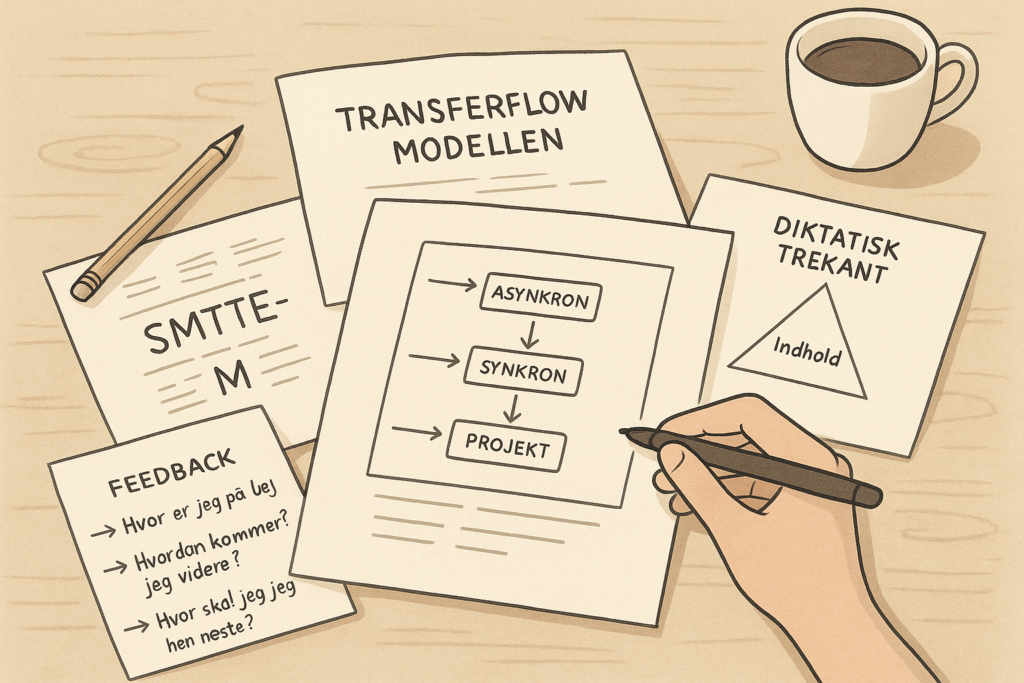
The Transferflow model is based on both practical experience and well-known didactic principles. It draws on the SMTTE model, feedback–feedforward–feed up, the didactic triangle, and many years of work planning and implementing online teaching.
The aim is not to replace existing theories, but to bring them together in a simple, usable structure that creates coherence and direction — for both students and teachers.